

RCDs and SPDs
What is an RCD?
An RCD, or residual current device, is a life-saving device which is designed to prevent you from getting a fatal electric shock if you touch something live, such as a bare wire. It can also provide some protection against electrical fires. RCDs offer a level of personal protection that ordinary fuses and circuit-breakers cannot provide.
What does an RCD do?
An RCD is a sensitive safety device that switches off electricity automatically if there is a fault.
An RCD is designed to protect against the risks of electrocution and fire caused by earth faults. For example, if you cut through the cable when mowing the lawn and accidentally touched the exposed live wires or a faulty appliance overheats causing electric current to flow to earth.
How does it work?
An RCD constantly monitors the electric current flowing through one or more circuits it is used to protect. If it detects electricity flowing down an unintended path, such as through a person who has touched a live part, the RCD will switch the circuit off very quickly, significantly reducing the risk of death or serious injury.
What are the main types of RCD?
RCDs can help protect you from electric shock in potentially dangerous areas like bathrooms and gardens, and there are various types of RCDs that can be used to make sure you are always as safe as possible.
Fixed RCDs
These are installed in the consumer unit (fusebox) and can provide protection to individual or groups of circuits. A fixed RCD provides the highest level of protection as it protects all the wiring and the sockets on a circuit, and any connected appliances.
Socket-Outlet RCDs
These are special socket-outlets with an RCD built into them which can be used in place of a standard socket-outlet. This type of RCD provides protection only to the person in contact with equipment, including its lead, plugged into the special socket-outlet.
Portable RCDs
These plug into any standard socket-outlet. An appliance can then be plugged into the RCD. They are useful when neither fixed nor socket-outlet RCDs are available but, as with socket-outlet RCDs, they provide protection only to the person in contact with the equipment, including its lead, plugged into the portable RCD.
Are RCDs reliable?
We’ve found that fixed RCDs are about 97% reliable. This improves if they are tested regularly. If you have fixed RCD protection, it will reduce the risk of electric shock to you and your family. It can also protect your home against the risk of fire caused by faulty wiring or appliances.
Remember – Although RCD protection reduces the risk of death or injury from electric shock it does not reduce the need to be careful. Have your wiring checked at least once every 10 years to ensure the safety of you, your family and your home. If you find a fault with your wiring, or an appliance, stop using it immediately and contact a registered electrician.
Don’t forget to test – You should test all fixed and socket RCDs about every three months. Manufacturers recommend that portable RCDs are tested every time you use them.
Beware – If you hold the test button in for a long time and the RCD does not switch off the electricity supply, then get advice from a registered electrician.
The UK standard for safety – Since July 2008 virtually all circuits in new or rewired homes have been required to include an RCD under the latest edition of BS 7671.
How much will RCD protection cost?
A plug-in RCD can cost as little as £10. A fixed RCD will cost more, but will provide a greater degree of protection to help keep your family safe. Installation costs will vary, so we recommend getting several quotes before proceeding.
How do I check whether I already have fixed RCD protection?
To check if you have fixed RCD protection, go to your consumer unit and have a look to see if there is a device with a pushbutton marked ‘T’ or ‘Test’. This ‘test’ button is part of an RCD. If an RCD is fitted, there should also be a label on or near the consumer unit stating ‘test quarterly’.
Types of RCD
Differing types of RCD are available; this section related to the various types.
For example reference is made to Type AC RCDs which are for general use and most common at present.
Reference is also made to Type A, Type F & Type B RCDs which also detect pulsating DC residual current.
The appropriate type of RCD should be selected for each application.
- Type AC – General purpose use
- Type A – Where smooth DC to 6mA exists
- Type F – Where smooth DC to 10mA exists
- Type B – Where smooth DC to 0.4 times rated operating current, or 10mA, whichever is higher
Type A is now recommended for all new domestic installations due to the increasing quantity of electronic items who’s power supplies can leak a little DC current back into the mains supply.
For EV charger installations Type A or B may be required and Solar photovoltaic (PV) power supply systems, Type B may be required.
Rating of RCDs
Typically RCD’s are rated at 30mA for fault protection for electrical shock. If you have an overhead power line supplying your property you should have an RCD rated at 100mA. This is for fire protection, and is not sufficent to provide electrical shock protection. 30mA RCDs should also be installed.
Surge Protective Devices (SPD)
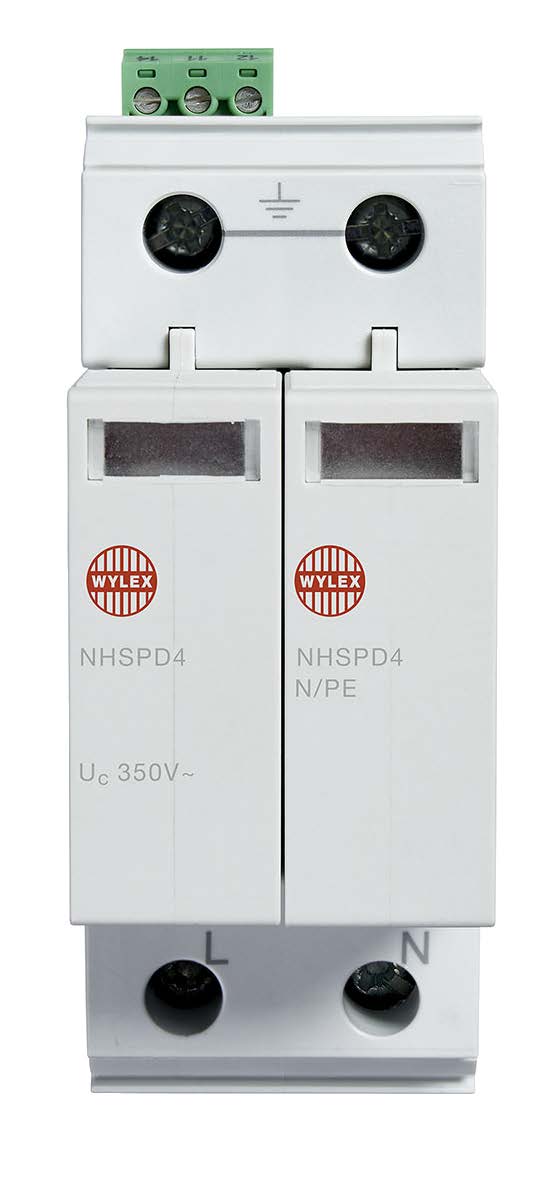
The effects of a surge can result in either instant failure or damage to the equipment only evident over a longer period of time. SPDs are usually installed within the consumer unit to protect the electrical installation but different types of SPD are available to protect the installation from other incoming services, such as telephone lines and cable TV. It is important to remember that protecting the electrical installation alone and not the other services could leave another route for transient voltages to enter the installation.
The Surge Protection Device (SPD) is a component of the electrical installation protection system.
This device is connected in parallel on the power supply circuit of the loads that it has to protect. It can also be used at all levels of the power supply network.
This is the most commonly used and most efficient type of overvoltage protection.

There are three different types of Surge Protective Devices:
- Type 1 SPD installed at the origin, e.g. main distribution board.
- Type 2 SPD installed at sub-distribution boards
- (Combined Type 1 & 2 SPDs are available and are usually installed in consumer units).
- Type 3 SPD installed close to the protected load. They must only be installed as a supplement to Type 2 SPD.
Where multiple devices are required to protect the installation, they must be coordinated to ensure correct operation. Items supplied by different manufacturers should be confirmed for compatibility, the installer and manufacturers of the devices are best placed to provide guidance on this.
What are transient overvoltages?
Transient overvoltages are defined as short duration surges of electricity which occur due to the sudden release of energy previously-stored or induced by other means. Transient overvoltages can be either naturally occurring or man-made.
How do transient overvoltages occur?
Man-made transients appear due to switching of motors and transformers, along with some types of lighting. Historically this has not been an issue within domestic installations but more recently, installations are changing with the advent of new technologies such as electric vehicle charging, air/ground source heat pumps and speed-controlled washing machines have made transients much more likely to occur within domestic installations.
Natural transient overvoltages occur due to indirect lightning strikes most likely to happen due to a direct lightning strike on an adjacent overhead power or telephone line causing the transient overvoltage to travel along the lines, which can cause significant damage to the electrical installation and associated equipment.
Do I have to have SPDs installed?
The current edition of the IET Wiring Regulations, BS 7671:2018, states that unless a risk assessment is carried out, protection against transient overvoltage shall be provided where the consequence caused by overvoltage could:
- Result in serious injury to, or loss of, human life; or
- Result in interruption of public services and/or damage to cultural heritage; or
- Result in interruption of commercial or industrial activity; or
- Affect a large number of co-located individuals.
This regulation applies to all types of premises which include domestic, commercial and industrial.
In the previous edition of the IET Wiring Regulations, BS 7671:2008+A3:2015, there was an exception for some domestic dwellings to be excluded from surge protection requirements, for example, if supplied with an underground cable, but this has now been removed and it is now a requirement for all types of premises including single dwelling units. This applies to all new build and properties being rewired.
Whilst the IET Wiring Regulations are not retrospective, where work is being carried out on an existing circuit within an installation which has been designed and installed to a previous edition of the IET Wiring Regulations, it is necessary to ensure the modified circuit complies with the latest edition, this will only be beneficial if SPDs are installed to protect the whole installation.
The decision on whether to purchase SPDs is in the hands of the customer, but they should be provided with enough information to make an informed decision on whether they wish to omit SPDs. A decision should be made based on safety risk factors and following a cost evaluation of SPDs, which may cost as little as a few hundred pounds, against the cost of the electrical installation and equipment connected to it such as computers, TVs and necessary equipment, for example, smoke detection and boiler controls.
Surge protection could be installed in an existing consumer unit if appropriate physical space was available or, if enough space was not available, it could be installed in an external enclosure adjacent to the existing consumer unit.
It is also worth checking with your insurance company as some policies may state that equipment must be covered with an SPD or they will not payout in the event of a claim.